
Kids with Crohn’s: The guide to help parents manage Crohn’s Disease with a liquid diet (EEN)

What is a liquid diet (medically known as EEN)?
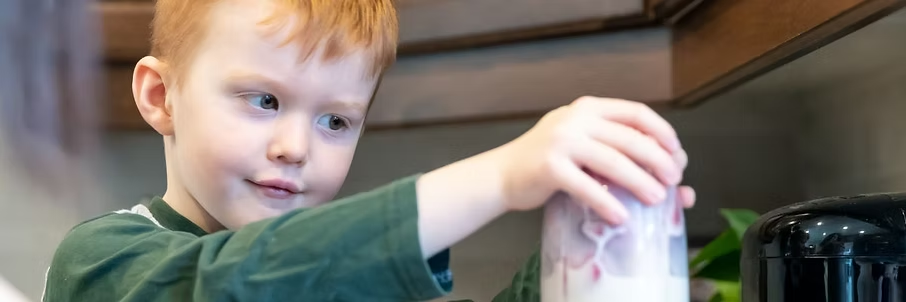
Exclusive Enteral Nutrition (EEN) is a dietary strategy where regular meals are replaced by a specially formulated liquid. The liquid is designed to provide all the nutritional needs including calories, protein, vitamins and minerals, to satisfy a child’s development as they work towards healing a diagnosis of Crohn’s Disease.
Why is my child on a liquid diet?
Your child is on a liquid diet (EEN) to support the management of conditions like Crohn’s. EEN is a thoroughly researched approach and a technique I have applied with success. The underlying rationale is to give the body the ability to focus on healing of the gut, rather than digesting food. EEN is a specially formulated liquid that provides the necessary nutrition during this stage of growth and development.
What is Crohn’s Disease in a child?
Crohn's disease is a type of inflammatory bowel disease (IBD). It presents as chronic inflammation in the digestive tract. In children, the condition can affect any part of the gastrointestinal tract, from the mouth to the anus.
What are the most common symptoms in children with Crohn’s?
- Abdominal pain,
- diarrhoea,
- weight loss,
- fatigue, and
- delayed growth.
What are the benefits of a liquid diet (EEN)?
A liquid diet (EEN) helps to:
- Reduce inflammation in the digestive tract, a key factor in managing Crohn’s disease,
- Improved symptom control, including reduced abdominal pain, diarrhoea and fatigue,
- Provides the right level of nutritional support to ensure proper growth and development,
- Promotes healing by temporarily replacing solid food with a liquid diet,
- Weight restoration by providing adequate calories for children who may have experienced weight loss due to Crohn’s disease,
- Promotes growth, important to address potential growth delays commonly associated with Crohn's,
- Addresses individual needs, as the liquid formulas can be tailored to meet the specific nutritional needs of the child,
- Improved quality of life, by minimising the impact of Crohn’s on a child’s daily life activities.
How long will my child need to be on a liquid diet (EEN)?
Your gastroenterologist will inform you of the length of time your child will be on EEN. In my experience, it is between 6 - 8 weeks, depending on the severity of the condition your child is experiencing.
How is a liquid diet (EEN) administered?
The liquid formula is prescribed through your GP or gastroenterologist as a nutritional drink they consume. We will trial this approach first, however if this is proving too difficult to achieve, your child may need to consider using a nasogastric tube to complete the full EEN period.

Here are some tips when following a liquid diet
- Consistency is key - stick to the exclusive liquid plan without solid foods, for optimal results
- Stay hydrated - to keep up their water intake, give your child cold drinks frequently
- Small, frequent sips - prevent hunger by taking small sips throughout the day rather than large quantities at once
- Be positive - offer praise and positive reinforcement to keep your child motivated
- Get them involved - help your child understand the importance of EEN and give them the power to make decisions, age appropriately
- Stick to a routine - to improve consistency and compliance, establish a routine to make it more predictable and part of daily life
- Create a support system - make your child feel supported by engaging friends, family and teachers
- Talk to your IBD team (gastroenterologist, dietitian, IBD nurse) if you have any questions or concerns
And some tips to improve compliance, by keeping your child interested in consuming the formula
- Change the texture by freezing the formula to a mousse style
- Make it into a frappe by blending it with ice cubes
- Warm the formula slightly, and let them enjoy the temperature change, like a hot chocolate
- Try different formula flavours to find their favourites
Other foods you can have during the EEN period
- Fruit teas (non caffeinated)
- Lemonade
- Polo mints
- Home made or packaged bone broths (e.g. Maggie’s bone broths)
How to reintroduce food after a liquid diet
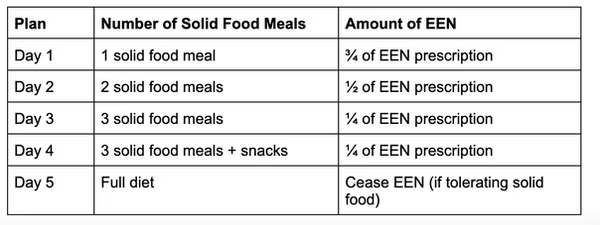
I will definitely guide you through this milestone event. Once your child’s gut shows improvements, which will be monitored with your Gastroenterologist, we will start the plan to reintroduce foods. In many cases, it’s a measured and gradual process, as the formula is reduced over several days as more solid food meals are introduced..
Here is a general guide on the meal plan we will follow:
What about the Crohn’s Disease Exclusion Diet (CDED)?
We will also consider the Crohn's Disease Exclusion Diet (CDED) as an alternative plan for your child if the initial EEN period is proving too difficult. This approach is on using whole foods, rather than only a liquid diet. The focus is on removing or lowering certain foods that are considered problematic for children with Crohn's disease. At the same time, it includes more of the foods that build a healthy gut microbiome. EEN is always a first option as it is the most evidenced based method for managing Crohn’s Disease.
It’s essentially a hybrid model, being a combination of food elimination, food reintroduction, supported with partial EEN. I’ve seen great results from following this plan but it requires a detailed discussion, which we will have during our consultation, once I get to know your child’s particular situation.
Why would CDED be considered?
EEN is a challenging diet for adults, let alone children. It’s extremely restrictive, making compliance difficult. In research studies, CDED has been proven to be as effective in its results with easier implementation.
In some instances we may even consider this approach in addition to EEN to maximise results for continued remission of Crohn’s Disease, after your EEN period has finished.
How can a certified Paediatric Dietitian help?
Once Crohn’s has been diagnosed I will work with you and your child to manage the nutritional treatment plan, including EEN and possibly CDED. I’ve worked with many patients and families through the process and bring all this experience to your situation. Following the initial consultation, I will be supporting your child through their individualised nutrition plan. Please feel free to ask any questions or raise concerns you encounter. I am there for you and your child.
Working with me is easy. Just follow these 3 steps and we’ll get you and your child on the road to peace, health and happiness.
Book an appointment
I’ll meet with you and your child via telehealth or face to face. We’ll discuss your child’s full history from birth until today and answer all your questions.
Get a customised nutrition plan
You’ll receive a nutrition plan that meets your child’s specific needs.
See your child thrive and their confidence grow
As your child’s digestion improves happiness will return to your mealtimes.

FAQ's: Your questions answered.
Every child’s situation is unique. This is the first step in my process, understanding your child’s discomfort. We’ll discuss what they are eating now, when they are experiencing tummy distress, and the severity of this distress. My goal is to help you find the root cause of the situation and create a nutrition plan you can implement at home that allows them to thrive.
Until we discuss your child’s situation it’s hard to say. But from years of experience and training I have a list of trigger foods we will look into, like dairy, gluten, greasy foods, and even fibre-rich foods.
As a paediatric dietitian, I always prioritise getting essential nutrients from food, rather than individual or multi-vitamins. However, in certain cases of gastroenterology disorders, where there may be specific nutrient deficiencies or impaired nutrient absorption, their body may need some extra help. That's when we consider adding in vitamins or supplements to make sure they're getting everything they need. Every child is different, so it depends on what your child specifically needs and how they're doing.
Yes there is evidence showing that cooking, and also serving food in a particular way, can make meals easier for your child to digest. Here are a few tips for you:
- Foods that are softer in texture - try steaming, boiling or slow cooking.
- Gentle seasoning - avoid heavy spices or seasonings. These include garlic, onion, chilli powder, strong curry blends and also highly acidic flavours such as lemon zest and vinegar.
- Consider giving your child smaller meals, more frequently. Smaller portions throughout the day can help prevent overwhelming their tummy and aid in better digestion.
- Be mindful of fibre. Excessive amounts can be challenging for some children with gastroenterology disorders. You can adjust the fibre content by choosing cooked, peeled, or blended fruits and vegetables instead.
Difficult to put a time on it. It depends on a number of factors - the severity of your child’s situation, their compliance to the suggested diet and their age are some of the considerations. But typically when trialling exclusion diet a minimum of 1 month is recommended. This will change based on your child’s diagnosis.
It’s hard for me to put a length of time on resolving a gastroenterology disorder. I have been able to solve some quickly and some others have taken more investigation, trial and effort. But rest assured, we will get to the root of the problem and determine a nutrition plan that works for them and for you.
Transitioning to a new dietary plan can be challenging for children. From my experience I have developed several strategies and techniques to help your child adapt to this new way of eating.
- Involve them in meal planning and grocery shopping. By giving them choices within the recommended options, they will feel a sense of control over their meals (of course, this depends on their age but even really young kids will let you know what they like and don’t in their own special way).
- Make it fun and creative - use colourful fruits and vegetables, make them into fun shapes or designs on their plate, let them help prepare like stirring the ingredients, and tasting the food along the cooking process.
- Gradual transition is best - instead of making dramatic changes, gradually introduce new foods, to allow them to adjust and develop a taste for the new flavours.
- Offer familiar foods with a twist. For example if they love spaghetti, try adding pureed veggies to the sauce for added nutrition.
- Role model healthy eating. Let them see you enjoying and appreciating nutritious foods.
- Provide education and explanations, at an age-appropriate level. Ask them how they feel on their new diet.
- Celebrate successes - acknowledge and celebrate your child’s efforts. Praise their willingness to try new foods, reinforcing positive behaviour.
Overall, patience, persistence and a positive approach go a long way in helping your child accept and enjoy the new dietary changes.
For allergy and intolerances I suggest looking at the Australian Society of Allergy and Immunology they have great educational resources on exclusion diets and management plans.
https://www.allergy.org.au/patients/information
For Eosinophillic Eosophagitis (EoE) ASCIA additionally has excellent resources for treatment and management medically and dietetically.
https://www.allergy.org.au/patients/food-other-adverse-reactions/eosinophilic-oesophagitis
Additionally an Australian based charity has a lot of resources and and support groups for families managing EoE.
Coeliac’s Disease also has great resources on Nutrition Education Materials Online. Additionally the Coeliac Society of Australia has great resources.
https://www.health.qld.gov.au/__data/assets/pdf_file/0026/149930/gastro-coeliac.pdf
Crohn’s Disease has some resources on Nutrition Education Materials Online and for more background information Crohn’s and Colitis Australia has further information.
https://www.health.qld.gov.au/nutrition/patients
https://crohnsandcolitis.org.au/
For irritable bowel syndrome Monash Health has great resources including books and apps. IBS is fairly unlikely in young children and should only be proceeded with after full assessment with your dietitian and gastroenterologist.
These are just some of the questions others have asked me. I’m sure you have questions that are specific to your child. Please contact me and we can talk about your child’s particular challenge and get to the root of the issue.